
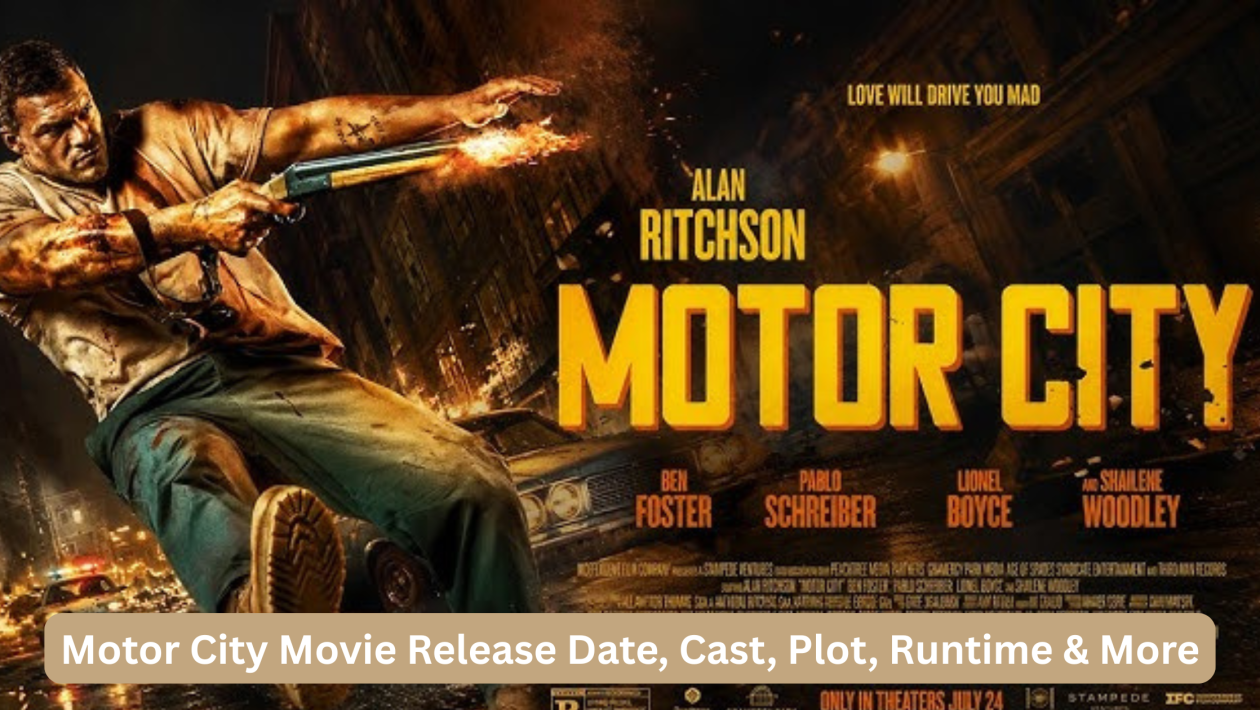
There’s a particular kind of excitement that builds when an actor known for one role tries something completely different, and that’s exactly what’s happening with Alan Ritchson right now. Fresh off his run as the hulking, no-nonsense Jack Reacher, Ritchson is stepping into a quieter, grittier world with a 1970s Detroit crime drama, and the project has already got people talking. Part of that comes from its cast, part from its setting, and part from something rare in modern cinema: a story told almost entirely without dialogue.
If you’ve been searching for the Motor City movie release date, here it is upfront, the film hits US theaters on July 24, 2026. That’s the headline number, but there’s plenty more worth knowing, from its near-silent storytelling style to a score composed by Jack White and the festival run that got it there in the first place. One quick note before going further: don’t confuse this with the unrelated 2011 film “Street Kings 2: Motor City,” a completely different movie despite the overlapping title and setting.
| Attribute | Details |
| Movie Title | Motor City |
| Release Date | July 24, 2026 |
| Genre | Crime Drama |
| Director | Potsy Ponciroli |
| Writer | Chad St. John |
| Lead Cast | Alan Ritchson, Shailene Woodley, Ben Foster |
| Character | John Miller |
| Setting | 1970s Detroit |
| Runtime | 103 minutes |
| Music | Jack White |
| Distributor | RLJE Films |
| Filming Location | Northern New Jersey |
| Language | English |
Motor City Movie Release Date
The motor city movie theatrical Release date is July 24, 2026. The film’s wide theatrical rollout in the United States lands on a Friday, which is standard practice for major movie releases since it gives a film a full weekend to build word-of-mouth momentum. RLJE Films, operating under the Independent Film Company banner, is handling the theatrical push, and industry chatter suggests they’re treating this as one of their biggest theatrical bets to date.
Don’t Confuse Motor City (2026) with Street Kings 2: Motor City (2011)
Because this trips people up more than you’d expect. Search “Motor City movie” without adding the year, and you might land on a 2011 direct-to-DVD crime film called Street Kings 2: Motor City, starring the late Ray Liotta. That film is a stand-alone follow-up to 2008’s Street Kings and also happens to be set in Detroit, which is exactly why the titles get muddled online.
The two films share nothing beyond a city name and a genre label. The 2011 movie centers on police corruption within a narcotics division and was released quietly with no theatrical presence to speak of. The 2026 film is a big-budget theatrical release with A-list names attached and a completely different plot built around romance and revenge. If you’re specifically hunting for the Alan Ritchson project and its confirmed release date, always double-check the year on whatever listing you’re viewing.
What Is Motor City About?
Set against the backdrop of 1970s Detroit, the story follows a wronged man on a mission of revenge, and it does so without leaning on real events or heavy dialogue to get there.
The story follows John Miller, a working-class man whose life gets upended when he falls for the girlfriend of a local gangster. Rather than letting it go, the gangster frames Miller for a crime he didn’t commit, sending him to prison for years. When Miller finally walks free, he isn’t looking for a quiet life; he’s looking for payback, and that pursuit forms the emotional and physical spine of the entire film.
It’s a fairly familiar setup on paper, but the execution is what’s turning heads. The film leans hard into atmosphere, using Detroit’s industrial decline and muscle-car culture as a visual backdrop rather than a setting mentioned only in passing. Expect gritty streets, period-accurate wardrobe, and a slow-burn tension that builds toward violent payoff moments rather than nonstop action sequences.
Is Motor City Based on a True Story?
No, it isn’t. Despite the specific time period and location, this is an original screenplay written by Chad St. John, not an adaptation of real events or a true-crime case. The 1970s Detroit setting was chosen deliberately for its cultural texture and its reputation as a city defined by both industry and hardship during that decade, but the characters and central conflict are fictional creations built for the screen.
The “Wordless” Storytelling Angle
This is probably the single most unusual thing about the entire project, and it deserves more attention than it’s gotten so far.
Why the Film Reportedly Has Only Five Lines of Dialogue
According to comments made by cast member Ben Foster, the film contains only a handful of spoken lines across its entire runtime. That isn’t a typo or an exaggeration for marketing purposes; it’s an actual creative choice the filmmakers committed to from the start. Most movies rely heavily on exposition, on characters explaining their motivations out loud, on quick verbal exchanges to move the plot forward. Stripping nearly all of that away forces the story to communicate through something else entirely, and that’s a genuinely bold swing for a film with this kind of budget and cast attached.
How Visual Storytelling Carries the Movie
So if characters aren’t talking, how does the audience follow along? Through performance, through camera work, and through sound design that does the heavy lifting dialogue usually handles. Director Potsy Ponciroli has described shooting the film as immersive on every level, meaning every frame and every sound cue was built with intention rather than filler.
This puts enormous pressure on the actors to convey grief, rage, longing, and calculation using only their faces and body language. Early festival reactions suggest that gamble paid off, with several attendees specifically praising the lead performance for carrying entire scenes without a single word being spoken.
Cast and Characters
The cast list alone is a big part of why this project has industry attention, so here’s a breakdown of who’s playing whom.
| Actor | Character | Known For |
| Alan Ritchson | John Miller | Reacher |
| Shailene Woodley | Sophia | Big Little Lies, The Fault in Our Stars |
| Ben Foster | Reynolds | Hell or High Water, The Messenger |
| Pablo Schreiber | Lieutenant Savick | Halo, American Gods |
| Benjamin McKenzie | Detective Kent | Gotham, The O.C. |
-
Alan Ritchson as John Miller
Ritchson carries the lead role as Miller, the wronged man at the center of the story. This is a notably different register from his work on Reacher, where sharp one-liners and confident dialogue were part of the character’s charm. Here, with almost no lines to work with, he’s relying entirely on physicality and expression to sell years of resentment and grief.
-
Shailene Woodley
Woodley plays Sophia, the woman at the center of the love triangle that sets the entire chain of events in motion, and her character carries her own arc tied to loyalty and consequence.
-
Ben Foster
Foster takes on Reynolds, the gangster whose jealousy kicks off the story, a role that fits his track record of playing morally complicated men.
-
Pablo Schreiber
Schreiber steps into the role of Lieutenant Savick, a law enforcement figure tangled up in the fallout of Miller’s frame job.
-
Benjamin McKenzie
McKenzie plays Detective Kent, adding another layer of institutional pressure to Miller’s pursuit of revenge. Together, this ensemble gives the film a lot of dramatic weight even before a single scene plays out.
Director, Writer, and the Team Behind Motor City
Beyond the cast, three creative voices shape how this film looks, reads, and sounds.
Potsy Ponciroli’s Vision
Director Potsy Ponciroli, previously known for Greedy People, described this project as a genuine love letter to Detroit and to the filmmaking style of the 1970s. In his own words, the goal was to shoot something immersive enough that every frame and every sound felt designed specifically for a theater experience rather than a streaming screen. Ponciroli’s comments suggest this was never meant to be background viewing; it’s built to be watched with full attention on a big screen.
Chad St. John’s Screenplay
Writer Chad St. John was tasked with building a revenge narrative that could function almost entirely on visual and emotional beats rather than dialogue-driven scenes. Most screenwriters lean on dialogue to establish backstory, motivation, and stakes, so stripping that tool away and still delivering a coherent, emotionally resonant plot says a lot about the structural planning that went into this script long before cameras started rolling.
Jack White’s Score
The film’s score comes from Jack White, the musician behind The White Stripes and one of the more distinctive sonic voices in contemporary rock music. Given how little dialogue exists in the film, the score isn’t just background music here; it’s practically doing the job that dialogue usually handles in other films, carrying emotional tone and signaling shifts in the story. Detroit has a deep musical identity, and pairing a Detroit-set crime story with a composer whose sound draws from raw, stripped-down rock instrumentation feels like a deliberate creative pairing rather than a random casting of talent, something worth remembering once the Motor City movie release date finally arrives.
Filming Location — Why New Jersey Played 1970s Detroit
Despite being set entirely in Detroit, the film was actually shot in northern New Jersey back in 2024. This is a common practice in filmmaking, since certain regions offer tax incentives, specific architectural textures, or logistical advantages that make them easier stand-ins for other cities, even when the story is tied closely to a particular place. For viewers, this likely won’t be noticeable at all; skilled production design, careful framing, and color grading can convincingly transform a location into somewhere else entirely.
Budget vs. Acquisition Deal
The film was made on a $30 million budget, yet the distribution deal that brought it to US theaters reportedly landed somewhere in the $3 to $4 million range. That gap might look strange at first glance, but it isn’t unusual in the independent film world. A production budget covers everything that goes into making the movie: cast salaries, crew, locations, post-production work, while an acquisition deal is simply what a distributor pays for the rights to release that finished film. Distributors are betting on future box office and licensing revenue, not reimbursing the full production cost upfront.
Runtime, Rating, and Format Options
Beyond the story itself, a few practical details will shape how you experience the film in theaters. The film runs for 103 minutes, which lands right in the sweet spot for this kind of story. Given the almost wordless approach to storytelling, a shorter runtime actually makes sense here. Sustaining a narrative without heavy dialogue for three hours would risk losing an audience’s attention, but under two hours keeps the pacing tight from start to finish.
What the Teaser Reveals
The teaser trailer, unveiled a few months ahead of the theatrical release, gives a strong sense of the film’s tone without giving away much of the actual plot. It leans heavily on mood, showing Ritchson’s character moving through dimly lit Detroit streets, quick flashes of violence, and glimpses of Woodley’s character that hint at the emotional core driving the revenge arc. True to the film’s overall approach, the trailer itself is fairly sparse on spoken lines, letting Jack White’s score set the tone instead.
Where to Watch Motor City
This film is currently running in theaters starting July 24, 2026. RLJE Films is handling a proper theatrical rollout rather than a day-and-date streaming release, which lines up with the director’s stated intention of making a film meant to be experienced on a big screen with proper sound.
As for streaming, based on typical patterns for independent theatrical releases of this size, a digital and VOD release usually follows somewhere between 30 to 90 days after the theatrical debut, though an official date hasn’t been locked in publicly yet. If a firm digital date gets announced closer to release, it’ll likely appear on major ticketing and streaming tracking sites first.
If You Like Motor City, Watch These Too
If the setup and tone of this film appeal to you, a few other titles share similar DNA and are worth adding to your watchlist.
- Drive: A quiet, stylish crime story built around a similarly reserved lead character and a moody, synth-heavy score doing much of the emotional storytelling.
- Baby Driver: Another film where music isn’t just a backdrop but an active part of how the story moves and feels.
- Hell or High Water: Coincidentally also starring Ben Foster, this one shares the same grounded, working-class desperation and slow-building tension.
Wrapping Up
Between its almost entirely wordless script, a Jack White score carrying much of the emotional weight, and a cast list stacked with genuinely strong performers, this movie is shaping up to be one of the more distinctive theatrical releases of the summer. If you’ve been keeping track of the Motor City movie release date, mark July 24, 2026 on your calendar, and if premium formats like Dolby Cinema are available near you, it might be worth the upgrade given how central sound design is to the entire experience.
FAQs
Q1. When is the Motor City movie release date?
The film releases in US theaters on July 24, 2026.
Q2. Is Motor City different from Street Kings 2: Motor City?
Yes, completely. Street Kings 2: Motor City is a separate 2011 direct-to-DVD film starring Ray Liotta, unrelated in plot, cast, and production.
Q3. Is Motor City based on a true story?
No. It’s an original screenplay by Chad St. John, set in 1970s Detroit but not drawn from real events.
Q4. How long is the Motor City movie?
The runtime of the movie is 103 minutes.
Q5. Where was Motor City filmed?
Despite being set in Detroit, the film was actually shot in northern New Jersey in 2024.
Q6. Will Motor City stream online, and when?
No official streaming date has been confirmed yet. A digital or VOD release will most likely follow a few months after the theatrical run, based on standard industry timelines.